One question came up on almost every panel at FEM EMEA this year: are we ready for what comes next in mobility?
It meant something slightly different to everyone who raised it. For some it was technology. For others it was the service model, regulation, or a team being asked to cover more ground with fewer people. But the question kept coming back, and so did the unease behind it.
Here is what we heard most often, what one of our clients said on stage, and what we think it adds up to.
What came up most
1. Complexity is rising, and demand is uneven. Traditional assignments keep declining. Relocation demand to the Middle East and Africa has dropped, which people put down to geopolitics. US immigration rules are changing quickly. Short-term and extended business travel across borders is growing. External events are reshaping what Mobility has to manage compliance for, often faster than programmes can adapt.
2. Technology still isn't clearing the basic hurdles. Nobody argued against smarter systems, better integration or more efficient processes. The frustration was with what gets in the way: integrations that fail, the cost of replacing legacy infrastructure, and provider and client systems that simply don't talk to each other. On AI, the view in the room was blunt. Fix those foundations first, or AI just gives you a faster version of the same problems.
3. Nobody can see where the money goes. Mobility costs flow across countries, legal entities and business-unit budgets. Supplier fees sit in one place and employee-related costs in another. That makes it hard to build a credible business case, and harder still to hold anyone accountable for spend.
From David Carmichael's session
David Carmichael of CGI joined Brian Friedman and Nitzan Yudan on stage to talk about how CGI's mobility function has changed over the last several years.
He was candid about the starting point. CGI ran separate tax, immigration and relocation vendors, at one stage used several relocation management companies, and tracked it all by hand. "It was Excel, emails and PowerPoint," he said. "We were 99% firefighting. That's the reality."
What CGI stopped doing
- Paying for duplicated layers of vendor management. CGI moved its relocation services onto a digital model with Benivo. David estimates it is now around 99% digital, with the traditional model still available when it is needed. On the relocation management vendor fees, he said: "We've probably seen a 50% reduction or so in the cost of running the vendors by going to a digital tool."
- Running mobility out of spreadsheets and inboxes. Over the past year CGI has extended the same platform into assignment management. Permanent transfers, commuters and international hires are all transitioning onto it, not just expatriates.
- Asking the business for new budget. CGI's mobility function recharges its costs to the business, so the change had to fund itself. "We had to make it pay for itself and we had to make it less than what we were paying before."
The outcome is a bigger job with a smaller team. "If I think back again to say 2018, 2019, the mobility function was primarily 400 expats. If I fast forward to now, it's 300 expats, 700 remote workers, 7,000 international hires, etc. But my head count has decreased."
And a different relationship with leadership. When a US immigration announcement landed, CGI's CHRO emailed David's team within about 15 minutes asking what the risk was. In the past, that question would have filtered through several layers of HR first. "He now understands the value of the Mobility CoE and knows to come to us direct for the answers."
The last question of the session was what he would tell someone about to renew an RMC contract. His answer: "Don't be constrained by what people believe to be the traditional relocation model. There are different options now."
What it tells us
Look back at the three problems above. None of them is really a headcount problem. CGI's team got smaller while its remit grew, so the answer is clearly not more people.
What people described is an operating model problem. Data sits in too many places. Providers don't connect. Costs can't be traced. Skilled mobility professionals spend their week chasing vendors and checking invoices instead of advising the business. Add people to that model and you get more people firefighting.
The usual fix has been an RMC for service plus a separate technology platform. That is two of everything: two contracts, two sets of fees, two sets of data, two places to look when something goes wrong, and Mobility in the middle reconciling them. It is also why AI layered on top tends to disappoint. It inherits the fragmentation underneath.
The alternative is one model with one owner. Experienced consultants who handle the move and the human side of it, a supplier network managed directly, and the platform that runs it all, in a single record, funded from the spend that already exists. High-touch support matters as much as ever when moves get complicated. The difference is that the people providing it are not buried in admin.
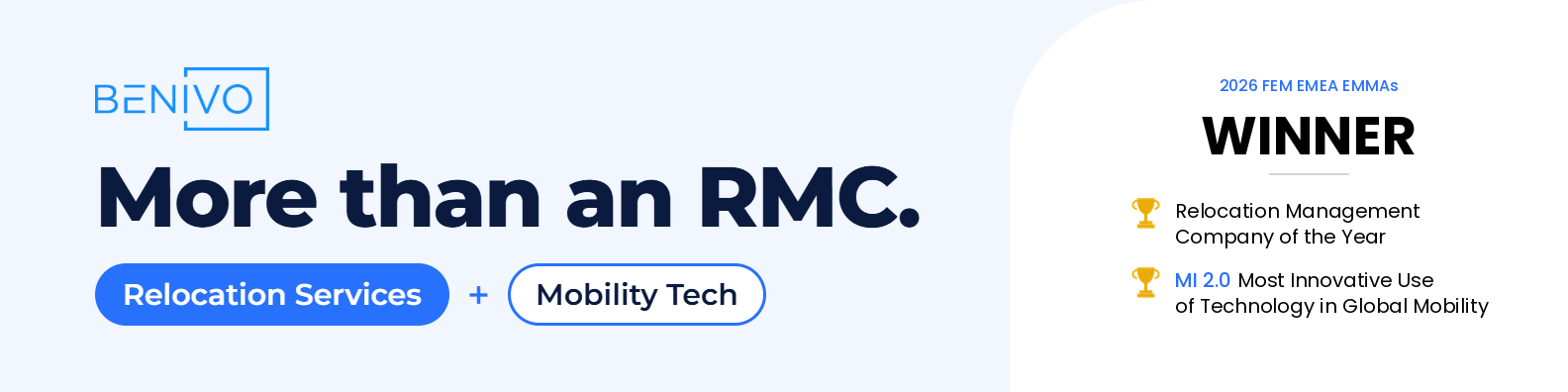
That is what we mean when we say Benivo is everything an RMC is, and more. It is also why we were proud to be named Relocation Management Company of the Year at the 2026 FEM EMEA EMMAs.
If we missed you
FEM EMEA was a busy few days and we didn't get to talk to everyone we wanted to. If you are weighing an RMC renewal, trying to get a clear view of mobility spend, or just want to compare notes on what you heard, we would like to hear from you.